
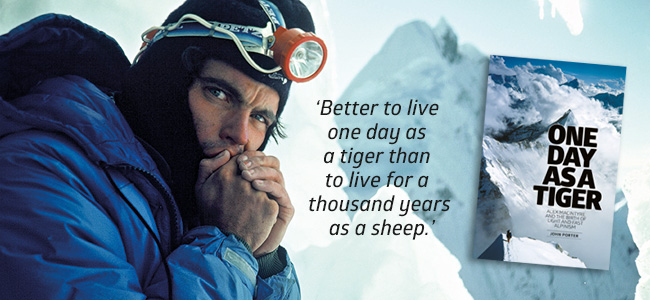
In the final chapters Porter explains how this was a very difficult book to write and how he agonised over whether it should even be written. Having struggled through the first 100 pages it's not the easiest book to read, never mind write, but there's absolutely no doubt it needed writing. At times you feel the author was, and is, too close to the events and subject matter to be objective, but does that mean it should never have been written? - No Way! It's a classic case of the sum of the whole being far more than the sum of its parts and has to be taken in its entirety.
By 1982 MacIntyre was an internationally recognised leader in a whole new style of climbing, pushing the boundaries of lightweight climbing but simultaneously he was an enigma. Legends and myths arose about him. He was the young, bright, future who'd taken on the suited fuddy-duddys of the establishment and won and I'll never forget how when he walked into the Moon (a long since gone pub) in Stoney Middleton there was an instant hush and an aura of reverence. Whispered "that's Alex MacIntyre"s spread as though a living deity had entered and stories of unimaginable exploits both preceded and followed his coming. 30 years on, meeting John Porter at ShAFF, and hearing that "the book" was finally going to be written I couldn't wait to find out the truths behind the legends and just how many of the stories were really true.
One Day As A Tiger is set in a golden era of Himalayan climbing and Alex MacIntyre was at the centre of it. It was an era when the cream of British climbing almost climbed itself into extinction as new ethics and philosphies saw the emergence of Alpinism in the planets great ranges. As a 21 year old in 82 Alex MacIntyre was amongst my heroes, along with the likes of Pete Boardman, Joe Tasker and Al Rouse. Their reputations struck a chord with the younger generation, not just for the bold lines they took but for their "anti-establishment" profiles. At a time when Thatcher's Britain seemed intent on crushing individualism and non-conformism Alex MacIntyre was our ray of light cutting through everything from the tradition-entrenched beuraucracy of the BMC to the closed borders of Cold War Europe. In many ways he was as much myth as reality, an ideal rather than a person. Through One Day As A Tiger the author uses the subjectivity of being a close friend and climbing companion to deliver an insight into what drove the real Alex MacIntyre.
The book opens with MacIntyre and Porter returning from Afghanistan before jumping 5 years forward to the fateful incident on Annapurna in chapter 2. It's not the easiest of reading, to be honest, and at times it feels almost sanitised - as though it were a climbing log book of "we did A then B" rather than an insight into the particpants' personalities. Stick with it though! The writing flits from first to third person and back, from interview to duplicating passage's of MacIntyre's own written words and you have to really concentrate at times to remember who is "I" and whose perspective you're seeing. By the time you reach the first of two collections of photographs, however, a clear picture of the man is emerging. The specifics of the routes he pioneered can be found in the record books and you can search them on Google, but until now there's been little written that looks at the person behind the achievements.
From boundary pushing routes on the world's highest mountains to his role as BMC National Officer Alex MacIntyre spearheaded a revolution in mountaineering. In writing One Day As A Tiger John Porter not only recounts the events of the time but examines MacIntyre's driving influences and the characteristics that set him apart from everyone else. The period that heralded "fast and light" also saw mountaineering face a real threat of government regulation and even mandatory insurance and MacIntyre was at the centre of both. In One Day As A TIger the author reveals a person who remained credible to both the establisment and the everyday climber. a man who could probably have excelled at whatever he chose to do in life and chose to climb. Perhaps thanks to the benfit of hindsight you also get the picture of a man who was changing, who was driven with a mission but was already contemplating an exit strategy. That he should leave such a legacy suddenly becomes obvious; how could he not have left a legacy - he was Alex MacIntyre.
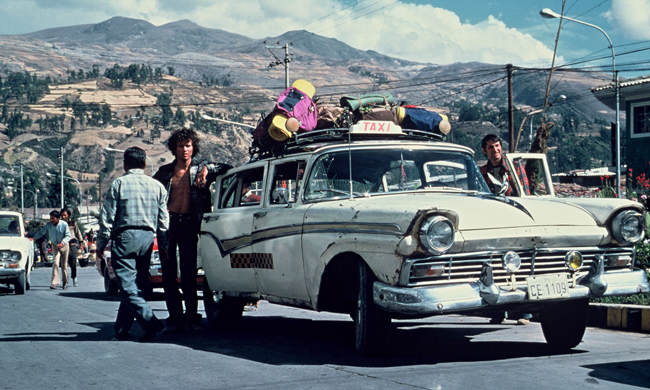
Alex MacIntyre (left) and John Porter taking a taxi to Laguna Peron base camp from Huaraz, courtesy of the Mount Everest Foundation.
Photo: John Porter.
If you're expecting an Andy Kirkpatrick style page turner of adventure, don't. There are whole chapters of trip reports but they serve not to describe the route or the adventure, but to display facets of a man who changed his world. The roll call of participants in the dramas reads like a Who's Who of mountaineering, with Voytek Kurtyka, the Burgess twins, Joe Tasker, Pete Boardman, Reinhold Messne, Doug Scott, Roger Baxter-Jones, Maria Coffey and Ken Wilson all taking to the stage. For anyone who lived through the late 70's and early 80's the names and personalities will be immediately familiar, while for anyone coming to the game later it proves a valuable insight into a world that was very different from today's. Many of those changes were directly attributable to the man who's name adorns the Alex MacIntyre Memorial Hut, and answers the question "Who was this Alex MacIntyre". The further into One Day As A Tiger you get the further you're pulled in; the attention to detail is minute enough that the book could serve as a historical record. There are times you'll laugh out loud and times you'll feel like crying. There are times the whole book feels like the expression of one man's love for another in the way the author portrays the leading character and times when you feel it's the necessary final act of grieving after 30 years. You'll find humour and sadness, triumph and disaster and in MacIntyre supreme self-confidence and vulnerability. In the same way that no account of Himalayan climbing would be complete without reference to Alex MacIntyre no reference to Alex MacIntyre would be complete without One Day As A Tiger.