
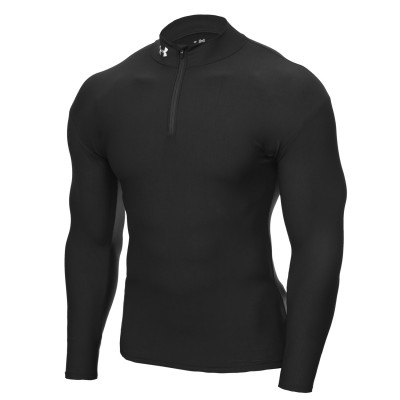
With a 15% of elastene in the baselayer guarantees a close fit and you can't just "throw" it on as with traditional baselayers, it's more like putting a wetsuit on with a fair bit of pullinga and stretching to get it right, but that's an essential part of the way Under Armour works. The idea behind the compression is to keep the body core, and muscles, at a constant and regulated temperature to allow the wearer to both perform at their best and recover quicker. An increase in body temperature can cause muscle fatigue and slow reaction times and the Under Armour Coldgear 1/4 zip uses a softer, brushed fabrication to combine enhanced thermal protection and moisture management with a fleece like feel for added comfort.
It takes a couple of hours to really get accustomed to the compression fit although while you can feel the compression on your chest it's in no way restrictive. Along with being a close fit the Coldgear 1/4 zip is quite generous in its length, easily reaching below waist level and requiring at least a short turn-up on the sleeves for the average user. With such a close, all encompasing, fit you soon build up a noticeably warm layer to the point that it seems inevitable that moisture will build up, but that's where Under Armour excels.
Field testing the garment in early February really put it to the test with temperature varying dramatically minute by minute as we moved from shade to sunshine and back again, regularly accompanied by icy blasts as we left the protection of the valley side which would drop again instantly. Maintaining a constant temperature under these conditions was never going to be easy, with just a Berghaus Smoulder Hoodie for insulation, but there was no danger of either chilling or building up excess moisture. The long fit eliminated the chance of any draughts around waist level and made for a complete upper body protective shell, while the 1/4 length zip did give a degree of "emergency" regulation when the warmth really built up - and even then there was no sign at all of the fabric absorbing sweat.
Overall we found the Coldgear 1/4 zip a little too warm for our liking in these conditions but in many ways that adds to the test given that even as someone who naturally runs very warm there was no build up of perspiration. We've no doubt at all that with the temperature a few degrees lower this baselayer would have been spot on for the conditions and although it's unlikely you'll ever forget you're wearing it it certainly seems to do what it claims.
Price: £45.00
Weight: 225g
Colour: Black, Black and Graphite
Features:
- Lock in rapid moisture transport and maximum core temperature regulation.
- Two layer brushed fabric combines enhanced thermal protection and moisture transport.
- Superior slip-on feel and compression fit make it a perfect active Base layer.
- Embroidered logo on neck.
- 66% Nylon / 19% Polyester / 15% Elastene.
- Quarter-Zip construction for on-demand ventilation.
Pros: Very good wicking. Warm. Cheaper than Merino
Cons: Not as odour resistant as merino
Note: This article was restored from the archives. It's published creation date is inaccurate.